A man is leaving on a business trip and stops by his office on the way to the airport. The night watchman stops him and says, “Sir, don’t take that flight. I had a dream last night that your plane would crash and everyone would die!” The business man cancels his trip and sure enough, the plane crashes, killing all the passengers. The man gives his watchman a $10,000 reward for saving his life, then fires him. Why?
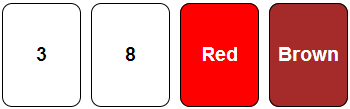
Four cards are placed in front of you on the table, each with a number on one side and a color on the other. The visible cards show 3, 8, red and brown. Which cards should you turn over in order to test the truth of the statement that if a card shows an even number on one face, then its opposite face is red?
You’d need to turn over only the 8 and brown card. Only a card with an even number on one face and which is not red on the other face can invalidate the stated rule. If you turn over the 3 card and it’s not red, it doesn’t invalidate the rule, nor does turning over the red card and finding it has the label 3.
This test was devised by Peter Cathcart Wason and is known as the Wason selection task. Less than 10% of test subjects got it correct in two separate studies.
In the marble walls as white as milk, Lined with skin as soft as silk, Within a fountain crystal clear, A golden apple does appear. No doors are there to this stronghold Yet thieves break in and steal the gold.
A couple has two children. At least one of them is a boy. Assuming the probability of having a boy or girl is 50%, what is the probability that both children are boys?
If you answered 1/2, you’re not without comrades, but the generally accepted answer by statisticians (though not without debate) is 1/3. This is because there are four possible combinations: boy-boy, boy-girl, girl-boy and girl-girl. Since we are told one of the children is a boy (but we don’t know if it’s the first or second child), we can rule out the girl-girl combination, leaving three remaining options. Only one out of 3 is boy-boy, so we get a 1/3 chance.